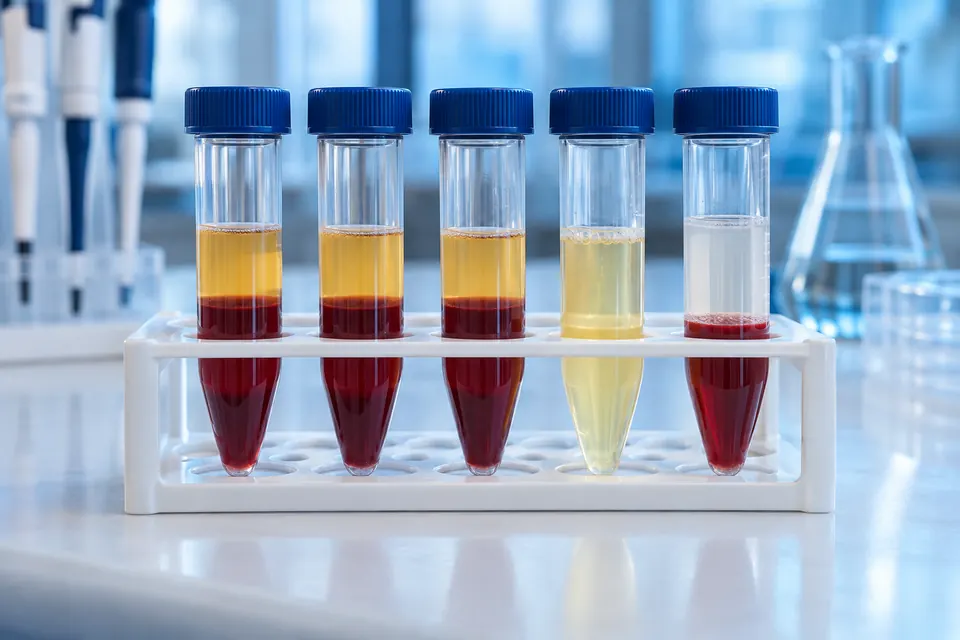
Four things called stem cells
Four things clinics may call “stem cell” treatment, how each is prepared and the questions to ask about each.
Clinics use “stem cell” loosely. Knowing which of these four you are being offered makes every other question easier.
| Type | Where from | How it is prepared | Ask |
|---|---|---|---|
| PRP | Your blood | Spun to concentrate platelets. Not a cell product. | Is this PRP or a cell product? |
| Bone marrow concentrate | Hip bone | Drawn and concentrated on the same day. | Does my condition fall within the assessed use? |
| SVF | Fat | A mixed cell fraction separated from fat, usually same day. | How much fat is taken, and from where? |
| Cultured cells | Fat or other tissue | Grown in a lab over weeks. | Which approval covers the culture and the use? |
From our partner clinic, Cell365 Well
Read the transcript
Put simply, stem cells are basic cells with the potential to become many kinds of cell. They can change in many ways. To put it more simply, imagine a work site that has broken down or been damaged. Someone has to fix it, and materials alone can't do the repair. Think of a technician who goes in and repairs it on site. A stem cell can play that technician's role. That's what makes it a useful cell. Leaving the complex science aside, where something is broken or needs repair, or where something is lacking, it's a technician that can work on it. That's a good way to think about it. Of course, the cells are taken from the patient's own body. The core principle is using your own cells. Using your own is what matters most, and using someone else's cells is not something we consider.
Read the transcript
We look for the best area. For women: the front of the abdomen, the love handles at the back or sides, and the back or inner thighs are common sites. Basically, we use the abdomen. But if there isn't enough there, or the fat isn't in good condition, or you've had a lot of liposuction before, we look for the area likely to work best. Usually the front of the abdomen first, the back second, and then the thighs. Men have much less fat than women, so we rarely take it from the thighs. It's hard. For men the abdomen comes first; if there isn't enough there, we take it from the back or sides, the love handles.
Stored cells
Some clinics offer to store cells for later use. Ask where they are stored, for how long, what it costs each year, and what happens to them if you stop paying.
At our partner clinic, Cell365 Well, enough fat is harvested to use cells on the same day and to freeze the extra (Cell Banking). Cells are stored in portions of one treatment area each, for five years as standard and up to 20 years on request. The clinic works with a specialist biotech company and research lab that hold patented technology for freezing and recovering cells, and it does not culture cells to multiply them.
Read the transcript
Besides the cells we use, we harvest enough to store some. We call it banking. Stored cells can be taken out when needed and used where you want. You don't use it all at once, so storage matters. We freeze and store the stem cells, so the procedure can be repeated whenever it's needed. It depends on how many portions you store. Each stored portion is for one area at a time. Put simply, ten portions mean ten areas, and twenty portions mean twenty. You can take out just one when you need it. We store them for five years. Most people use them before five years are up, usually within one to three years. If you wish, much longer storage is possible, up to 20 years.
Questions
Is PRP a stem cell treatment?
No. PRP is plasma with platelets prepared from your own blood. A cell preparation is a different product. Ask the clinic which one it proposes.
Is SVF the same as cultured stem cells?
No. SVF is a mixed fraction of cells separated from fat tissue, usually on the same day. Cultured cells are grown in a lab over weeks and fall under different rules.
Read next

Not sure where to start?
Send your question and any X-ray or MRI report you have. COMEDI, the registered coordinator that runs this guide, replies in writing and can ask a clinic for its written answer and an itemised quote.